VC questions for startups in Vietnam are becoming more rigorous, reflecting a market where capital is still available but expectations are rising. Active funds such as Do Ventures, Ascend Vietnam Ventures, VinaCapital Ventures, 500 Startups Vietnam, and CyberAgent Capital continue to invest actively from seed to Series A, but with far greater selectivity than in previous cycles.
Here are additional VCs actively investing in breakout startups across Vietnam and the region:
As the bar for funding continues to rise, Vietnamese founders who understand “what do investors want”—and how to answer their questions—now gain a crucial advantage.
This article walks through the most common VC questions, how to respond effectively, practical preparation tips drawn from recent guidance from global and local investors, and a case study of how one of Vietnam’s best-known startups navigated its fundraising journey.
Common VC Questions For Startups In Vietnam
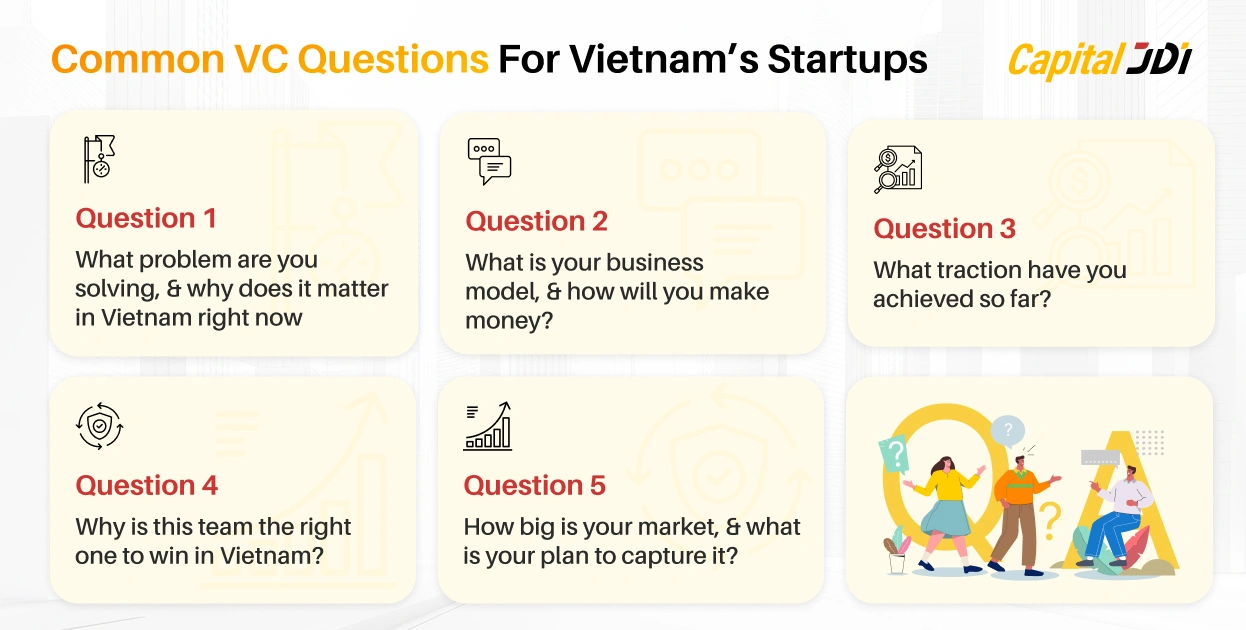
While every firm has its own style, there is strong global convergence on the core VC questions for startups – around problem, model, traction, team, and market.
In Vietnam, these questions are typically framed through a local lens—regulation, infrastructure, consumer behavior, and competition from regional giants like Grab, Shopee, and MoMo.
Below are five of the most common themes, with the underlying “why” and practical guidance on how to answer.
Question 1: What problem are you solving, and why does it matter in Vietnam right now?
Why VCs Ask:
Investors want to know if the startup is attacking a real, painful, and sizable problem in the Vietnamese context—rather than a “nice-to-have” or a copy of a foreign idea that ignores local realities.
With sectors like fintech, e-commerce, and edtech growing rapidly off the back of high internet penetration and a young, digital-native population, the question tests whether the founder understands:
-
-
- The specific Vietnamese customer segment and pain point
- Why is this problem urgent over the next 3–7 years
- Why is now the right time
-
How To Answer Effectively:
-
-
- Anchor in a specific user: e.g., “70% of Vietnamese SMEs still manage invoices in Excel and Zalo, leading to delayed payments and cash-flow crises.”
- Quantify the pain: use data from credible sources (government reports, industry studies) to show scale.
- Localize: reference Vietnamese-specific frictions—regulation, infrastructure, trust, behavior.
- Tie to timing: link the problem to current trends such as digitalization policies or post-COVID consumer shifts.
-
* A clear, concise 60–90 second explanation, grounded in Vietnam’s realities, signals a strong founder–market fit.
Question 2: What is your business model, and how will you make money?
Why VCs Ask:
Among the core VC questions for startups, this is one that seed and Series A investors in Vietnam now scrutinize much more closely, as they are far more focused on sustainability and efficiency than in earlier “growth at all costs” cycles. Understanding “what do investors look for in a company” becomes essential here.
They want to see:
-
-
- How revenue is generated
- Whether the economics can work in Vietnam (pricing power, margins, cost structure)
- How the model scales across cities and, ideally, across Southeast Asia
-
How To Answer Effectively:
-
-
- Use a simple structure: customer → value → revenue → unit economics.
- Be explicit: e.g., “We charge SMEs a monthly SaaS fee of 500,000 VND plus a 1% transaction fee on payments processed.”
- Show basic unit economics: CAC, LTV, gross margin, and payback period, even if still early.
- Acknowledge local constraints: e.g,. lower ARPU, cash-heavy behavior, fragmented logistics.
-
* Investors are not expecting perfect numbers at seed, but they do expect a coherent path to positive unit economics within a reasonable timeframe (often 18–36 months).
Question 3: What traction have you achieved so far?
Why VCs Ask:
Traction is the cleanest signal of product–market fit. In a more disciplined funding environment, investors in Vietnam prioritize evidence of adoption over PowerPoint projections, particularly in high-noise spaces like e-commerce and fintech.
That’s why, within the broader set of VC questions for startups, traction-related metrics often become the deciding factor.
How To Answer Effectively:
– Lead with hard metrics rather than anecdotes:
-
-
- Users: total, MAU/DAU, and growth rate
- Revenue: MRR/ARR, take rate, GMV where relevant
- Retention: cohort retention, churn, repeat purchase rate
-
– Add a Vietnam-specific distribution story: e.g., partnerships with local banks, telcos, or co-working spaces; traction via Zalo, TikTok, or Facebook.
– If pre-revenue, highlight credible signals:
-
-
- Pilots or LOIs with Vietnamese enterprises
- Successful POCs with quantifiable outcomes (e.g,. “reduced delivery costs by 25% for 50 HCMC retailers”)
-
* The most persuasive answers are visual, data-backed, and honest about both strengths and gaps.
Question 4: Why is this team the right one to win in Vietnam?
Why VCs Ask:
Team strength is consistently ranked among the top criteria for early-stage investors globally—making it one of the most pivotal VC questions for startups. In Vietnam, where execution risk is amplified by fragmented infrastructure and evolving regulation, investors focus heavily on:
-
-
- Founders’ operational track record
- Local insight and networks
- Complementarity of skills
-
How To Answer Effectively:
-
-
- Present a tight narrative: “The CEO spent 8 years in SME lending at a top Vietnamese bank; the CTO led a 30-person engineering team at a major local tech firm; the COO previously scaled nationwide logistics operations.”
- Emphasize Vietnam-specific experience: regulatory navigation, understanding of second-tier cities, relationships with local partners.
- Highlight balance: business + technical + operations, not three generalists with overlapping skill sets.
- Mention advisors selectively: only if they are truly engaged and add credibility (e.g. former executives from leading Vietnamese tech companies).
-
* Clear founder–problem fit, rooted in Vietnam’s context, is often more compelling than generic global credentials.
Question 5: How big is your market, and what is your plan to capture it?
Why VCs Ask:
VC funds are designed around power-law returns; they need companies capable of reaching a large scale. For Vietnam, this often includes a path from local dominance to regional expansion across Southeast Asia, where the digital economy is projected to reach US$200 billion by 2025.
How To Answer Effectively:
– Use a clear TAM–SAM–SOM breakdown:
-
-
- TAM: regional/global opportunity
- SAM: Vietnam-specific slice
- SOM: realistic share over 5–7 years
-
– Ground numbers in credible sources and bottom-up logic.
– Explain the initial focus: the city/segment where the startup can win first (e.g., SMEs in HCMC and Hanoi).
– Outline expansion logic: into adjacent customer segments, verticals, or nearby countries (e.g., Cambodia, Laos, or Indonesia) with similar pain points.
* The best responses to these VC questions for startups show both ambition (large potential) and discipline (staged, testable steps to get there).
→ Want to walk into your investor meeting fully prepared? Explore our latest investor-aligned checklist for Southeast Asia
How to Prepare Well for Your Next Pitch
Several recent guides from VC and startup ecosystems globally emphasize a similar set of preparation fundamentals: deep investor research, a sharp deck, strong financials, and rigorous practice.
Here are five of the most relevant tips for Vietnamese founders raising seed or Series A, each designed to help you master how to attract investors, alongside a set of common VC questions for startups.

Tip 1: Research Each VC And Tailor The Pitch
Vietnamese founders today pitch to a wide and diverse investor base: local early-stage funds such as Do Ventures and Ascend Vietnam Ventures, regional players like Monk’s Hill Ventures and Openspace, and corporate VCs like CyberAgent and NTT’s Synexia.
Understanding this landscape is essential not only for positioning your company but also for anticipating which VC questions for startups each investor may prioritize.
Effective preparation includes:
-
-
- Understanding each fund’s stage, ticket size, sectors, and existing portfolio.
- Identifying whether the startup fits clearly within their thesis.
- Adapting examples and emphasis in the deck to align with the investor’s focus (e.g., emphasizing regional scalability for a regional fund, or strategic synergies for a corporate VC).
-
This level of homework signals seriousness and respect for the investor’s time.
For a deeper framework on how top VCs assess founders and pitches, refer to our detailed guide.
Tip 2: Build A Concise, Compelling Pitch Deck
A strong pitch deck is your first chance to address many of the VC questions for startups before the meeting even begins. Founders who understand how to pitch to investors know that the goal isn’t to overwhelm with detail but to deliver a clean and visual narrative.
Most experienced VCs recommend a deck of 10–15 slides that gives them the clarity to evaluate opportunities in startups. A common structure of a winning pitch includes:
-
-
-
- Title & mission
- Problem (in Vietnam/SEA context)
- Solution/product demo
- Market (TAM/SAM/SOM)
- Business model
- Traction: Financials & key metrics
- Go-to-market
- Competition and differentiation
- Team
- Funding request and use of funds
-
-
For Vietnam-based startups, adding a single slide on “Why Now in Vietnam?”—highlighting policy shifts, consumer behavior, or infrastructure readiness—often strengthens the narrative.
Tip 3: Strengthen Financials And Assumptions
Recent fundraising trends in Vietnam and SEA point to a clear shift toward capital efficiency and faster paths to profitability, making financial clarity even more critical when addressing these VC questions for startups.
Before meeting investors, founders should:
-
-
- Prepare a 2–3 year financial model with revenue projections, cost structure, and cash runway.
- Show key assumptions transparently: pricing, conversion rates, churn, and hiring plans.
- Run simple scenarios: base case, optimistic, and conservative.
- Factor in local realities: inflation, FX movements, and the cost of talent and logistics in Vietnam.
-
The objective is not to predict the future perfectly, but to demonstrate disciplined thinking about growth and risk.
Tip 4: Leverage Vietnam’s Startup Community And Events
Networking remains a primary source of VC deal flow worldwide, and warm referrals are often the difference between a cold email being ignored and securing a serious first meeting.
In Vietnam, founders can significantly improve their odds by:
-
-
- Engaging with local accelerators and programs such as Founder Institute Vietnam, Zone Startups Vietnam, or corporate innovation initiatives.
- Participating in pitch competitions and meetups like Techfest Vietnam, Vietnam Venture Summit, or sector-specific conferences.
- Building relationships with ecosystem players—other founders, angels, and advisors—who can provide warm introductions to top VCs.
-
Such visibility and connectivity not only elevate your profile but also strengthen your ability to assess your investment readiness level with greater clarity.
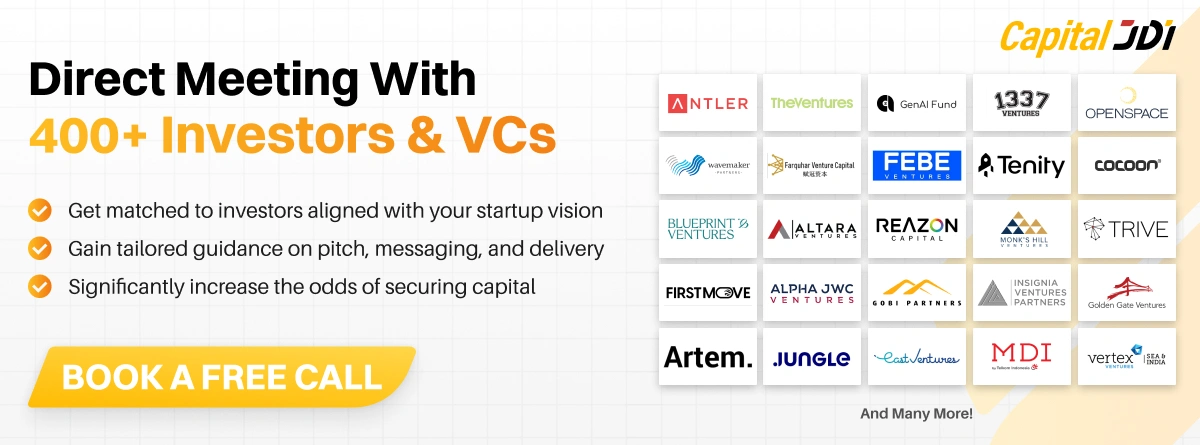
Facing hurdles in building the right investor network? Capital JDI can help you strengthen your positioning and connect with the right VCs.
Tip 5: Practice Relentlessly And Seek Honest Feedback
Across markets, experienced VCs emphasize that how a story is told matters almost as much as the underlying metrics. Effective practice for Vietnamese founders includes:
-
- Rehearsing the pitch out loud, multiple times, ideally in English and Vietnamese if both will be used.
- Running mock sessions with other founders, mentors, or local angel investors.
- Recording practice pitches to identify filler words, unclear slides, or weak transitions.
- Preparing for Q&A with a list of likely questions across product, tech, competition, unit economics, and regulation.
The goal is not to memorize a script, but to be comfortable enough with the narrative to handle interruptions and deep dives.
If you’re raising Seed or Series A in SEA and need investor-level insights on your deck, metrics, and strategy, schedule a free call with our expert.
Need More Guidance? Get Expert Support from Capital JDI
For founders in Vietnam raising seed or Series A, venture capital is still very much on the table! However, investors are more selective, more data-driven, and more focused on local execution than ever before.
These VC questions for startups are not hurdles for the sake of it—they are a roadmap to building a stronger, more resilient company in one of the world’s most exciting emerging markets.
If you’re ready to secure funding and present a story investors truly believe in, Capital JDI is here to help you get there.
To go deeper, access our Investor Checklist Guide for a clear breakdown of what top VCs expect before they commit.
And if you’re ready to accelerate your fundraising momentum, join our Next Wave Capital Program to position your startup for a successful round—supported by strategic guidance, investor access, and growth-focused mentorship.